

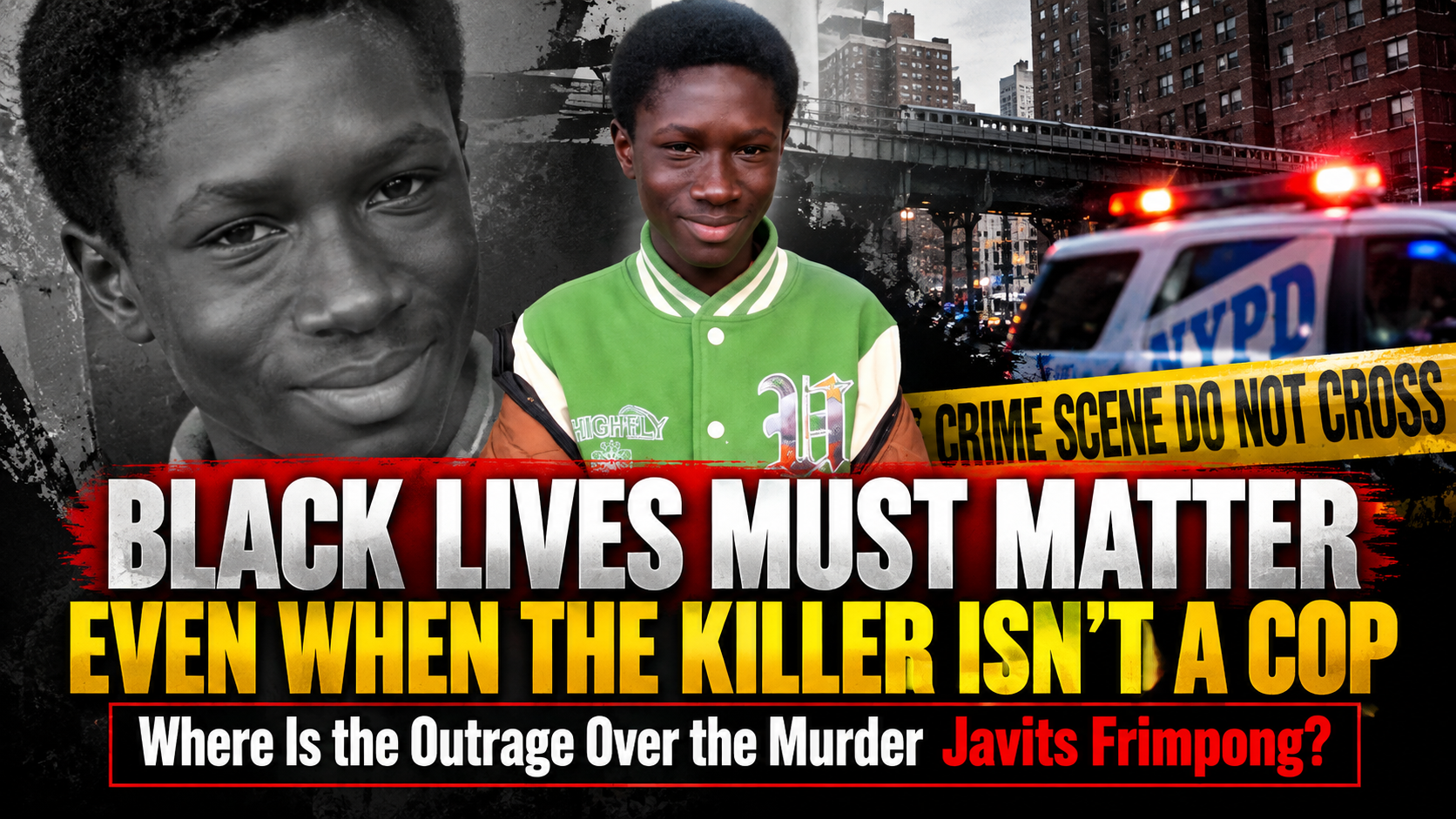
A 15-year-old Black boy left home to go to school in the Bronx and never returned. His name was Javits Frimpong. He was a young man whose family had come to America from Ghana seeking opportunity and a better future. Instead, his family is now facing the unimaginable pain of burying a child who should have had his entire life ahead of him. According to news reports, Javits was shot while traveling to school. His father has alleged that his son had been bullied and that school officials knew about the problem. Police have not established whether that bullying was connected to his murder.
Before we talk about politics, activism, or accountability, we need to remember that this was somebody’s child. Somebody who had dreams, friends, fears, and a future. His parents sent him to school expecting him to come home. Instead, they received news that no mother or father should ever have to hear. As I watch this tragedy unfold, I find myself asking a question that should make every Black organization, civil rights leader, elected official, and community activist uncomfortable.
Where is the outrage?
ACCOUNTABILITY MUST WORK BOTH WAYS
I spent 33 years in law enforcement, and throughout those years, I fought for accountability on both sides of the badge. I challenged misconduct, questioned institutional failures, and demanded that law enforcement professionals be held to the standards their authority requires. But I have also challenged the behavior within our own communities that contributes to violence, instability, and the destruction of Black families.
I have never believed accountability should depend on someone’s race, occupation, political affiliation, or uniform. If a police officer violates someone’s constitutional rights, that officer must be held accountable. If an ICE agent unlawfully uses force, that conduct deserves investigation and accountability. But when a Black child is murdered in our own community, where is that same organized demand for justice? Where are the community meetings, public demonstrations, emergency conversations, and leaders demanding solutions?
We cannot continue acting as though Black lives only become a national priority when the person accused of taking one wears a badge.
THE SELECTIVE OUTRAGE THAT IS DESTROYING OUR CREDIBILITY
Over the years, I have watched how quickly certain organizations and personalities mobilize when an incident involving law enforcement becomes a racial controversy. Before the complete facts are known, social media platforms are flooded with commentary. Cameras arrive, microphones appear, and activists who were nowhere to be found the week before suddenly become the loudest voices demanding justice.
Sometimes that outrage is absolutely justified. We have witnessed real cases of police brutality, unlawful killings, discriminatory enforcement, and government misconduct. I have personally challenged those problems, and I will continue to do so. But legitimate outrage over police misconduct does not excuse our unwillingness to confront violence within our own neighborhoods.
What concerns me is the growing culture of internet influencers and what I call protest profiteers. These are people who have learned that racial controversy can generate followers, donations, media appearances, and political influence. Every incident becomes an opportunity to build a personal brand. Every confrontation becomes content. Every tragedy involving law enforcement becomes another chance to position themselves as the voice of Black America.
I am not suggesting every activist operates this way. There are dedicated people doing difficult, often thankless work to protect our communities. But we must be willing to question those who appear whenever racism can be attached to a headline yet seem absent from the difficult, everyday work of addressing violence among our own people.
If your activism only becomes visible when there is a white officer, an ICE agent, or an allegation of racism, people have every right to question the consistency of your commitment to Black lives.
WHERE ARE OUR CIVIL RIGHTS ORGANIZATIONS?
As of this writing, I have been unable to locate verified public statements specifically addressing the murder of 15-year-old Javits Frimpong from several prominent civil rights organizations, including Black Lives Matter Global Network Foundation, Black Lives Matter Greater New York, the national NAACP, the NAACP New York State Conference, the NAACP Bronx Branch, the National Action Network, the National Urban League, the New York Urban League, the Black Alliance for Just Immigration, the Movement for Black Lives, Color of Change, and Black Youth Project 100.
That does not establish that these organizations have done nothing, and I welcome any statements or actions that have not yet come to public attention. But it raises a question that deserves an answer: Where is the same highly visible, sustained mobilization against the violence taking the lives of Black children in our own neighborhoods?
We have organizations capable of organizing national demonstrations, mobilizing thousands of supporters, and demanding accountability from police departments and government agencies. Why shouldn’t that same organizational power be directed toward protecting our children from the senseless violence happening in our communities every day?
I am not claiming these organizations have never addressed community violence. Some chapters, members, and local leaders have supported anti-violence initiatives for years. But I am asking whether preventing the murder of Black children receives the same consistent organizational attention as cases involving alleged police misconduct.
Where are the coordinated campaigns addressing youth shootings? Where are the sustained efforts to confront bullying, gang recruitment, illegal firearms, and retaliation? Where are the partnerships with parents, educators, community organizations, and credible violence-prevention workers?
A press conference after a police shooting may be necessary, but protecting Black children requires more than reacting to tragedy. It requires showing up before the next child is killed.
WHAT ABOUT THE VIOLENCE WE DO TO EACH OTHER?
We need to have an uncomfortable conversation about violence taking place in Black communities. Not because Black Americans are inherently more violent than anyone else, and not because we should ignore the economic and social conditions that contribute to crime. We need this conversation because children are dying, families are suffering, and too many people have accepted violence as an unavoidable part of everyday life.
We talk about racism, discrimination, poverty, unemployment, and unequal educational opportunities. Those are legitimate issues deserving attention. But we must also discuss personal responsibility, parental involvement, conflict resolution, community relationships, and the normalization of violent behavior.
We have young people who cannot settle disagreements without threatening each other. We have children being bullied, intimidated, and humiliated while adults struggle to intervene effectively. We have neighborhoods where residents are afraid to cooperate with investigations because they fear retaliation. We have families who lose children to violence and then watch the public move on to the next trending controversy.
I refuse to accept the argument that discussing violence within our communities somehow excuses racism or gives ammunition to those who already hold negative opinions about Black people. That thinking places political image above human life. We cannot build safer communities by refusing to acknowledge the problems that exist within them.
Black accountability is not anti-Black. It is a necessary part of Black progress.
OUR ELECTED OFFICIALS MUST ANSWER TOO
Every election season, politicians visit Black churches, community centers, housing developments, and neighborhood businesses asking for our votes. They talk about protecting Black communities, improving public safety, supporting education, and creating opportunities for young people. But when another child is murdered, we need more than condolences and carefully written statements.
What are the measurable results of the programs being funded in our neighborhoods? Are schools effectively addressing bullying and threats? Are violence-prevention organizations being evaluated on outcomes rather than political relationships? Are parents being included in discussions about school safety?
In Javits Frimpong’s case, his father’s allegations about bullying deserve serious examination. If school administrators knew his son was being threatened or harassed, the public deserves to know what actions were taken, whether those actions were sufficient, and whether anyone had information suggesting the situation could escalate into violence.
That is not an accusation that the school caused his death. It is a demand for answers about whether opportunities to protect a child were missed.
WE CANNOT POLICE OUR WAY OUT OF EVERY PROBLEM
After 33 years in law enforcement, I understand the importance of professional standards, constitutional protections, and holding government employees accountable for misconduct. I also understand that no police department, no matter how well staffed or trained, can solve the problem of community violence by itself.
Public safety requires responsible policing, strong families, functioning schools, credible community leadership, and residents who refuse to normalize destructive behavior. It requires parents willing to correct their children, adults willing to intervene before conflicts escalate, and organizations willing to do the unglamorous work that rarely generates social media attention.
I am tired of watching people turn Black suffering into political currency while the difficult work of strengthening our communities receives a fraction of the attention. I am tired of the assumption that every problem in Black America must have an external villain before we can organize around it.
We have every right to demand justice from government institutions. But we also have an obligation to demand responsibility from ourselves.
Accountability cannot stop at the badge.
BLACK LIVES MUST MATTER EVERY DAY
Javits Frimpong should be alive today. He should be worrying about homework, friendships, graduation, and what he wants to become as a grown man. His parents should be preparing him for adulthood, not preparing to bury him.
His death must not become another headline that disappears after a few days. It should force us to examine what we value, what we tolerate, and whether the organizations claiming to represent Black America are addressing the full range of threats facing our children.
I am not interested in competing over which tragedy deserves more attention. I am interested in establishing one consistent standard: Every Black life deserves protection, every victim deserves justice, and every person responsible for unlawful violence deserves accountability.
Whether the person pulling the trigger wears a police uniform, a federal badge, or a hoodie, the value of the life taken does not change.
To the Frimpong family, I offer my deepest condolences. Your son’s life mattered, and the questions surrounding his death deserve answers.
To the activists, influencers, civil rights organizations, and elected officials who claim to speak for Black America, I offer this challenge: Show our children that their lives matter before they become victims, not simply when their deaths become politically useful.
Only Black America Can Save Black America.
