

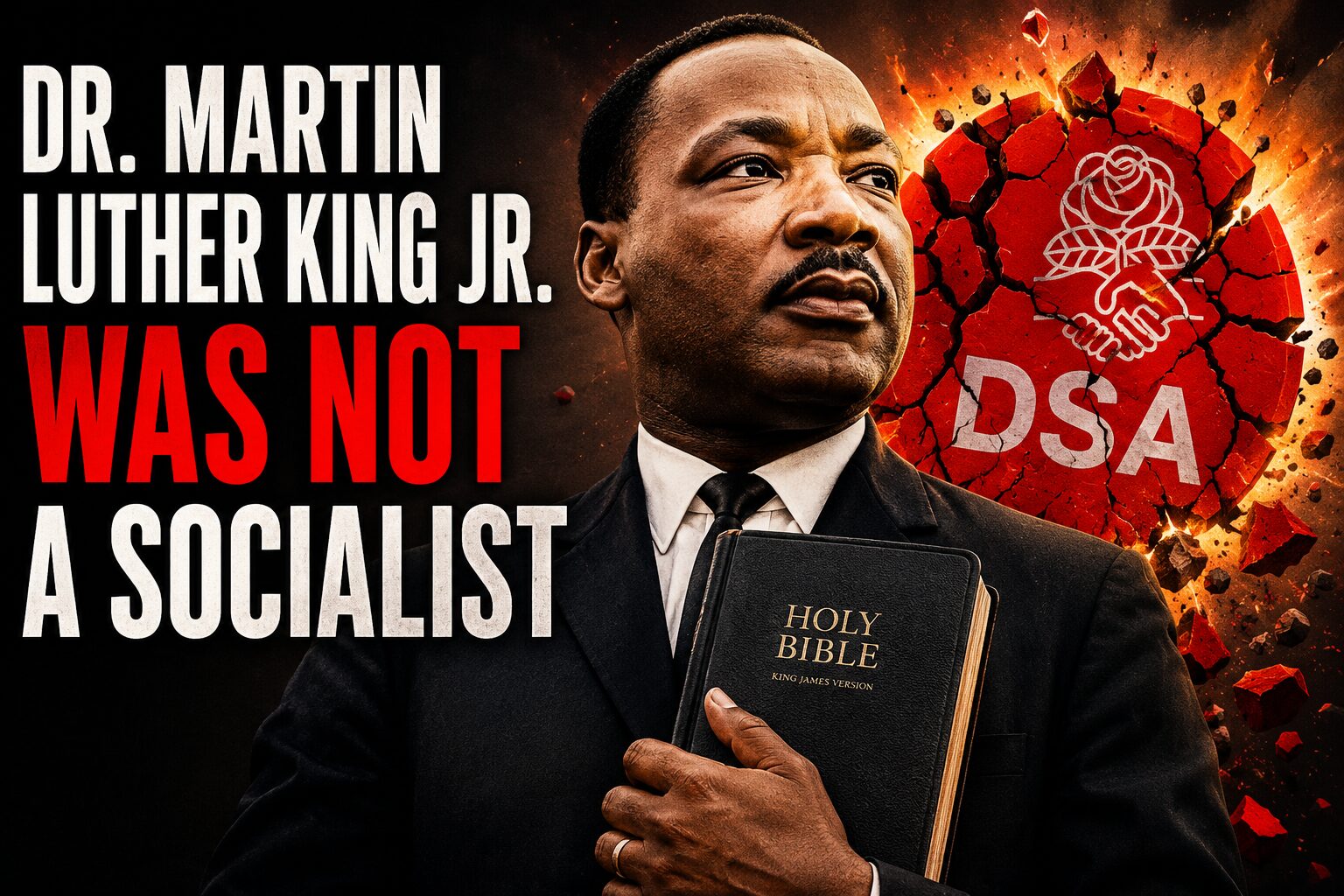
The debate over Dr. Martin Luther King Jr.’s economic views has become so loud that many Americans have forgotten the foundation upon which he built his life. Before anyone attempts to define Dr. King as a socialist, a capitalist, a conservative, or a liberal, they must first answer a more important question: What was the source of his worldview?
The historical record leaves little doubt. Dr. King was, first and foremost, a Baptist minister. His calling was not politics—it was the Gospel. Long before he became America’s most recognizable civil rights leader, he was preaching the death, burial, and resurrection of Jesus Christ, calling sinners to repentance, and teaching that Scripture—not government, political parties, or economic theories—was the ultimate authority for both the individual and society.
That historical fact matters because it explains everything that followed. The Civil Rights Movement was not born in the headquarters of a political party. It was born in the Black Church. It was organized in sanctuaries, sustained through prayer meetings, led by pastors, strengthened by biblical preaching, and carried forward by congregations who believed that justice was not merely a constitutional principle but a command from God.
Jesus declared, “The Spirit of the Lord is upon me, because he hath anointed me to preach the gospel to the poor…”(Luke 4:18, KJV). The prophet Micah wrote, “He hath shewed thee, O man, what is good; and what doth the LORD require of thee, but to do justly, and to love mercy, and to walk humbly with thy God?” (Micah 6:8, KJV). These passages were not political slogans for Dr. King. They were the theological foundation upon which he understood justice itself.
This is where many modern interpretations go wrong. They begin with twenty-first-century political ideologies and then work backward, attempting to fit Dr. King into categories that did not define his ministry. In doing so, they often confuse biblical ethics with political ideology.
The Bible commands believers to feed the hungry, care for the poor, defend the widow, protect the fatherless, and pursue justice. Those commands existed thousands of years before Karl Marx, Adam Smith, the Democratic Party, or the Republican Party. They belong to God, not to any economic system. To suggest that biblical concern for the poor is, by itself, evidence of socialism mistakes a shared concern for a shared foundation.
This distinction is essential because similar policy positions do not necessarily arise from the same worldview. Two people can support helping the poor while arriving at that conclusion from entirely different first principles. Dr. King’s first principle was the Gospel of Jesus Christ. His understanding of justice flowed from Scripture, his courage flowed from his faith, and his willingness to suffer flowed from his conviction that obedience to Christ required both sacrifice and love.
If we ignore that foundation, we do more than misunderstand Dr. King. We risk rewriting the history of the Black Church itself. If we are willing to redefine Dr. King primarily through a modern political ideology, we are also willing to redefine the movement that produced him. The struggle of the Black Church cannot honestly be detached from the Gospel without changing its very identity.
There is also a warning that Black pastors cannot afford to ignore.
We are living through a political moment in which nearly every historical figure is being reinterpreted through the lens of modern ideology. Dr. Martin Luther King Jr. is no exception. If we are not careful, the history of the Black Church’s struggle for justice will be remembered not as a movement rooted in the Gospel of Jesus Christ, but as the product of political ideologies that neither created it nor sustained it.
Black pastors must understand what is at stake. This is not simply a debate about Dr. King’s economic views. It is a debate about the spiritual foundation of the Civil Rights Movement itself. If that foundation is replaced, future generations may come to believe that the movement’s greatest source of power was political theory rather than biblical truth.
The Black Church did not march because it had the best political strategy. It marched because it believed God’s Word required justice. It did not endure bombings, jail cells, intimidation, and death because of loyalty to an economic system. It endured because it believed, “We ought to obey God rather than men.” (Acts 5:29, KJV)
The Apostle Paul reminds us, “For we wrestle not against flesh and blood, but against principalities, against powers, against the rulers of the darkness of this world, against spiritual wickedness in high places.” (Ephesians 6:12, KJV) The struggle of the Black Church has always been spiritual before it was political. Politics was the arena in which the struggle was fought, but faith was the reason the struggle existed.
My concern is that if pastors remain silent while the spiritual roots of the Civil Rights Movement are minimized or reinterpreted, we may unintentionally allow future generations to inherit a version of history that remembers the marches but forgets the prayers, remembers the speeches but forgets the sermons, and remembers the legislation but forgets the Lord.
None of this means Dr. King’s economic proposals are beyond debate. Citizens and scholars can reasonably disagree about public policy, the role of government, or how best to address poverty. Honest debate about policy is healthy in a free society. What should not be lost is the historical reality that Dr. King’s ministry was grounded in the Gospel before it ever entered the public square.
Dr. King preached repentance, forgiveness, reconciliation, personal responsibility, moral character, nonviolence, and salvation through Jesus Christ. Those were not side notes to his ministry. They were the foundation upon which everything else rested. His public advocacy flowed from his Christian faith.
As Jesus taught, “But seek ye first the kingdom of God, and his righteousness; and all these things shall be added unto you.” (Matthew 6:33, KJV)
Whether one agrees with every economic proposal Dr. King advanced is a legitimate question for debate. But if we remove Christ from Dr. King’s message and replace the Gospel with political ideology, we have not preserved his legacy—we have rewritten the foundation upon which it was built.
